This past Sunday I had the opportunity to speak in Sacrament Meeting. I was excited when I was told my topic: Raising a Righteous Posterity. After all of my research for this blog, this was definitely a topic I could talk about! Here is the text of my talk. It was supposed to be a 15-18 minute talk, so it’s pretty long!
Raising a Righteous Posterity
Being a parent is an awesome and somewhat daunting responsibility. Satan’s tactics are convincing, and his attacks on the family are alarming: drug and alcohol abuse, pornography, immorality, violence, and divorce are just a few of the hazards that lead to the breakdown of the family. Fortunately, there is a way to combat the evils of the world.
Elder Joseph B. Wirthlin stated: “The place to cure most of the ills of society is in the homes of the people. Building our homes as fortresses of righteousness for protection from the world takes constant labor and diligence. Membership in the Church is no guarantee of a strong, happy family. Often parents feel overwhelmed.”
“In the plan of salvation, all families are precious instruments in the Lord’s hands to help direct His children toward a celestial destination. The righteous molding of an immortal soul is the highest work we can do, and the home is the place to do it. To accomplish this eternal work, we should make our homes gospel centered. When peace and harmony abound, the Holy Spirit will ever be present. The storms of the evil one can be stopped at the very entrance of our homes.” (Joseph B. Wirthlin, “Spiritually Strong Homes and Families,” Ensign, May 1993, 68)
Let me emphasize, “The righteous molding of an immortal soul is the highest work we can do, and the home is the place to do it.” Today I will be speaking on the topic of raising a righteous posterity. This is something that I have thought a lot about, even before I became a mother. In college at BYU I chose to major in Marriage, Family, and Human Development because I wanted to learn all that I could to prepare me to be the best wife and mother I could be. Now I find myself spending my free time reading parenting books and blogs; I even have my own blog focused primarily on nurturing mothers and children.
Fortunately, being a parent today doesn’t require a college degree, and you are not expected to spend hours upon hours researching the latest parenting interventions. What is required of parents is a focus on Heavenly Father and his son, Jesus Christ. As Helaman taught his sons: “…remember, remember that it is upon the rock of our Redeemer, who is Christ, the Son of God, that ye must build your foundation; that when the devil shall send forth his mighty winds, yea, his shafts in the whirlwind, yea, when all his hail and his mighty storm shall beat upon you, it shall have no power over you to drag you down to the gulf of misery and endless wo, because of the rock upon which ye are built, which is a sure foundation, a foundation whereon if men build they cannot fall.” (Hel. 5:12.)
Families who work together to build a strong foundation, a foundation that is centered on the Savior and the principles of his gospel, are the families that will come out victorious in the end. Today I am going to go back to the basics by discussing five essential building blocks for building a strong foundation for our families, a foundation that will strengthen our children against the temptations that they will face.
The five essential building blocks I will address are: living the principles of the Family Proclamation, prayer, scripture study, family home evening, and showing love.
Building Block #1: Live the Principles of the Proclamation
The fist essential building block for the foundation of a strong family is living the principles contained in “The Family: A Proclamation to the World”. I hope each of you have a copy of the Proclamation in your home and refer to it often. This document is truly scripture for our day; it provides the mandate we need as parents to raise righteous children.
I would like to share paragraph seven from the Proclamation with you: “The family is ordained of God. Marriage between man and woman is essential to His eternal plan. Children are entitled to birth within the bonds of matrimony, and to be reared by a father and a mother who honor marital vows with complete fidelity. Happiness in family life is most likely to be achieved when founded upon the teachings of the Lord Jesus Christ. Successful marriages and families are established and maintained on principles of faith, prayer, repentance, forgiveness, respect, love, compassion, work, and wholesome recreational activities. By divine design, fathers are to preside over their families in love and righteousness and are responsible to provide the necessities of life and protection for their families. Mothers are primarily responsible for the nurture of their children. In these sacred responsibilities, fathers and mothers are obligated to help one another as equal partners. Disability, death, or other circumstances may necessitate individual adaptation. Extended families should lend support when needed.”
There is a lot of doctrine contained in that one short paragraph! In 2009, the Primary children focused on just one key sentence for the entire year: “Happiness in family life is most likely to be achieved when founded upon the teachings of the Lord Jesus Christ.”As the Primary children recited that statement every week, I was often struck by its significance and I hope that the children remember its importance as they grow older.
In a devotional address at BYU, Elder M. Russell Ballard offered specific, encouraging words: “To parents everywhere, my counsel is simple: Get a copy of “The Family: A Proclamation to the World.” Read it and strive to align your marriage and your family to its inspired, revealed direction from the Lord. Then, be the very best and act the very best you can. God will give you strength beyond your own as you strive daily to fulfill the most sacred mortal responsibility He gives to His children. Listen to the voice of the Spirit and the counsel of the living prophets. Be of good cheer. God did not place you on earth to fail, and your efforts as parents will not be counted as failure unless you give up.” (M. Russell Ballard (2003, August 19). “The Sacred Responsibilities of Parenthood,” BYU Devotional Address.)
Building Block #2: Prayer
The second essential building block for the foundation of a strong family is prayer. Prayer provides protection like nothing else can. In the April 2009 General Conference, President Thomas S. Monson said, “Prayer is the provider of spiritual strength; it is the passport to peace. Prayer is the means by which we approach our Father in Heaven, who loves us. Speak to Him in prayer and then listen for the answer. Miracles are wrought through prayer.”
Make time to pray with your children, morning and night. Admittedly, family prayer in our home right now, with two young children, is usually not very reverent. But we are establishing a pattern so our children know that we are a family that prays together, and as President Monson likes to say “The family that prays together, stays together”. It’s best to set a regular time and stick with it. In our house we say family prayer in the evening, just before our girls go to bed. Morning prayer is something that we have been working on improving lately, and since we have worked it into our routine and made a plan for it, we have been much more successful.
As your children get older, scheduling family prayer will become more difficult. I read of a mother who got up early with a teenage son and said a prayer with him before he left for early morning seminary, and then would say prayers again when the rest of the family woke up. Be flexible, and do what works best for your family.
It is essential to make time for your own prayers. Heavenly Father hears the prayers of parents. President Monson said “We often feel overwhelmed by the task before us. However, help is ever at hand. He who knows each of His children will answer our fervent and heartfelt prayer as we seek help in guiding them. Such prayer will solve more problems, alleviate more suffering, prevent more transgression, and bring about greater peace and contentment in the human soul than any other way” (Thomas S. Monson, 2006. “Heavenly Homes, Forever Families,” Worldwide Leadership Training Meeting).
I testify that my prayers, especially when it comes to family concerns, have been heard and answered by a loving Heavenly Father.
Building Block #3: Scripture Study
The third essential building block for the foundation of a strong family is regular study of the scriptures. President Spencer W. Kimball taught “Scripture study as individuals and as a family is most fundamental to learning the gospel. Daily reading of the scriptures and discussing them together is a powerful tool against the temptations of Satan. This practice will produce great happiness and will help family members love the Lord and his goodness. Home is where we become experts and scholars in gospel righteousness.” (President Spencer W. Kimball, The Teachings of Spencer W. Kimball, p. 129).
Prophets through all ages taught the importance of studying the scriptures, both individually and as a family. But what the prophets haven’t said specifically is how that should be done. In all of my research I have never read where a prophet commanded “Thou shalt read 42 verses a day in your family”. And no prophet ever said “Thou shalt read 5 verses per family member every morning and night”. The nice thing about family scripture study is that it can be tailored to meet the needs of each family.
In our house we read a verse of scripture in the morning, prior to family prayer. We also try to read a few verses in the evening as the girls are getting ready for bed. We have also made use of the Book of Mormon stories scripture reader, as well as the Gospel Art Picture Kit, both resources produced by the church. In addition, we make sure to use our scriptures during Family Home Evening. Now that Anwyn is reading, it is exciting for her to find and highlight scriptures in her own copy of the Book of Mormon. Lily asks often for her “diptures”, and likes to carry them around with her and in the car. It is never too early to introduce your children to the scriptures.
Building Block #4: Family Home Evening
The fourth essential building block for the foundation of a strong family is weekly Family Home Evening. In 1915, the First Presidency instructed local leaders and parents to begin a home evening, a time when parents should teach their families the principles of the gospel. The Presidency wrote: “If the Saints obey this counsel, we promise that great blessings will result. Love at home and obedience to parents will increase. Faith will be developed in the hearts of the youth of Israel, and they will gain power to combat the evil influence and temptations which beset them” (http://www.lds.org/hf/statements/0,16955,4232-1,00.html).
Family Home Evening is for everyone: couples, families with younger or older children, single parents, grandparents and others. Everyone should be involved, even young children. Our daughter Anwyn recently taught her first lesson in our Family Home Evening and it was a great learning experience for all of us. President Faust counseled that “We should do all we can to free up Monday evenings from any other competing activities. Like glue, family home evening bonds us together as families. Lessons should be instructive and involve family members in a relaxed atmosphere which includes an expression of love (James E. Faust, “Challenges Facing the Family,” Worldwide Leadership Training Meeting, Jan. 10, 2004, 2–3. ).
When it comes to preparing lessons, there are many resources available to help. We often rely on the lesson manuals produced by the Church. The new Nursery manual, Behold Your Little Ones, is fabulous for those with small children. All of the lessons are available online at lds.org. We also depend a lot upon the church magazines, the Friend and the Ensign. Our lessons are usually short, and we try to include some type of game or hands-on-activity to actively engage our children. And of course, this isn’t a requirement, but at our house we like to end with a treat!
A year ago I was pondering about ways that I could improve both the quality of our family scripture study and our Family Home Evenings. I decided that I could start by making sure to focus on the scriptures each week during Family Home Evening. Here is how it works for us:
1) We plan a family home evening lesson.
2) We chose a scripture that corresponds with the lesson.
3) We read and discuss the scripture as a family at FHE.
4) We make a poster to display the scripture. This is really simple. I just type it up large to fill an 8.5 by 11 sheet of paper and then I tape it up on the wall near our kitchen table.
5) Then we refer to the scripture and talk about it throughout the week.
It’s a pretty simple thing, but it has made a difference in our family. We usually end up discussing it during mealtimes, and it allows us to review the key concepts from the lesson. We don’t spend a lot of time on it (and we aren’t required to memorize it), it just gives us a reminder or a starter for a gospel discussion with the children each day.
Focusing on one verse a week is a nice, manageable amount for our young children. A number of times Anwyn has surprised me by memorizing the scripture, and in all cases she ends up reading the scripture on her own at some point–a bonus for encouraging literacy skills in early readers!
Building Block #5: Show Love
The fifth essential building block for the foundation of a strong family is show love to your children. Last fall during General Conference, Elder Bednar gave an excellent talk called “More Diligent and Concerned at Home”. One of the ways that parents can be more diligent and concerned at home is simply “by telling the people we love that we love them.” Don’t worry about trying to be fancy or elaborate with your words, simple expressions of love are just fine.
Elder Bednar questions: “Brethren and sisters, when was the last time you took your eternal companion in your arms and said, “I love you”? Parents, when was the last time you sincerely expressed love to your children? Children, when was the last time you told your parents that you love them? Each of us already knows we should tell the people we love that we love them. But what we know is not always reflected in what we do. We may feel unsure, awkward, or even perhaps a bit embarrassed.”
There is more to love than just saying the words. Do your children know from your actions that you love them? Spend time with them, listening and playing and laughing. Make happy memories together. Be their biggest cheerleader and offer encouragement. Read books and blow bubbles and play games and explore the world together. I love all of the church commercials that state “Family—isn’t it about time?”. Demonstrate your love to your children by giving them your most precious commodity—your time and attention.
Recently I read President Uchtdorf’s talk from the April 2009 General Conference, “We Are Doing a Great Work and Cannot Come Down”. He spoke about using the guidance of the Holy Ghost to focus on what matters most in life, and he encouraged us to take some time to reflect on whether our actions really line up with what our hearts are telling us to focus on.
As you consider what is most important in your life, listen to these words from The Family: A Proclamation to the World: “Husband and wife have a solemn responsibility to love and care for each other and for their children. “Children are an heritage of the Lord” (Psalm 127:3). Parents have a sacred duty to rear their children in love and righteousness, to provide for their physical and spiritual needs, and to teach them to love and serve one another, observe the commandments of God, and be law-abiding citizens wherever they live. Husbands and wives—mothers and fathers—will be held accountable before God for the discharge of these obligations…By divine design, fathers are to preside over their families in love and righteousness and are responsible to provide the necessities of life and protection for their families. Mothers are primarily responsible for the nurture of their children. In these sacred responsibilities, fathers and mothers are obligated to help one another as equal partners.”
Now, I’m sure I’m not the only person who feels that my “to-do” list is much longer than the hours available in my day: Clean the house, make nutritious meals, work on food storage, develop my talents, exercise, read good books, teach my children, support my husband, go visiting teaching, write in my journal (or blog!), go grocery shopping, magnify my calling…all of these things are good things, but it’s nearly impossible to do all of them every day. The key here is balance, and it’s something that I am really trying to work on. Some days I do better than others, and some days I wish I could do things over.
President Uchtdorf counsels “We cannot and must not allow ourselves to get distracted from our sacred duty. We cannot and we must not lose focus on the things that matter most.” As a wife and a mother, my most important role is to nurture my family. How I carry out that role is a matter of prayer between myself and the Lord, and it’s going to look different for every woman and every family.
In the October 2008 General Conference, President Monson also spoke about recognizing what is important and what is not. In regards to parenting, he said “If you have children who are grown and gone, in all likelihood you have occasionally felt pangs of loss and the recognition that you didn’t appreciate that time of life as much as you should have. Of course, there is no going back, but only forward. Rather than dwelling on the past, we should make the most of today, of the here and now, doing all we can to provide pleasant memories for the future. If you are still in the process of raising children, be aware that the tiny fingerprints that show up on almost every newly cleaned surface, the toys scattered about the house, the piles and piles of laundry to be tackled will disappear all too soon and that you will—to your surprise—miss them profoundly (Thomas S. Monson, “Finding Joy in the Journey,” Liahona, Nov 2008, 84–87).
To conclude, President Hinckley offered these wise words: “You have nothing in this world more precious than your children. When you grow old, when your hair turns white and your body grows weary, when you are prone to sit in a rocker and meditate on the things of your life, nothing will be so important as the question of how your children have turned out. It will not be the money you have made. It will not be the cars you have owned. It will not be the large house in which you live. The searing question that will cross your mind again and again will be, How well have my children done? (Gordon B. Hinckley, “Your Greatest Challenge, Mother,” Ensign, Nov 2000, 97–100”.
I bear testimony that the family is of God. Heavenly Father has given parents a great responsibility, but he does not leave us without guidance. May we each strive to build a strong foundation for our families by focusing on living the principles of the Family Proclamation, prayer, scripture study, family home evening, and showing love. Our lives and the lives of our children will be blessed. I know that we have a living prophet on the earth today who leads and guides the church. I know that our Savior lives, and that Heavenly Father loves each of us and wants us to return to live with him again.
In the name of Jesus Christ, amen.
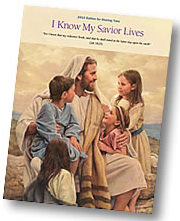 2010 Outline for Sharing Time
 Ch. 5: The Creation
 General Conference Addresses, October 2009
 The Ensign, March 2010
 The Friend, March 2010


