This past Sunday I had the opportunity to speak in Sacrament Meeting. I was excited when I was told the topic: How to have a happy marriage. Along with nurturing mothers, I am also pretty passionate about strengthening marriages! Here is the text of my talk; it was supposed to be a 15 minute talk so it is a little lengthy, but read on if you like!
How to have a Happy Marriage
As a student at BYU, I earned my degree in Marriage, Family, and Human Development. Some of you might smile a little at that title, and you might question “what kind of a degree is that?” and “what good is a degree in marriage and family in the real world?”
Well, let me tell you a little about the real world. Current projections predict that “approximately 50 percent of married couples in the United States will divorce before either the husband or wife dies. The divorce rate for couples in second marriages is even higher, approaching 60 percent. A significant number of married couples in the United States also give divorce serious consideration but then decide to stay married” (Brent Barlow, “Eternal Marriage begins in Mortality”, Ensign, October 2005).
President Hinckley had this to say in 2003. “I have witnessed much of the best and much of the worst in marriage. Every week I have the responsibility of acting on requests for cancellation of temple sealings. Divorce has become a very common phenomenon throughout the world… I am grateful to be able to say that divorce is much less frequent with those married in the temple. But even among these there is far more divorce than there should be.” (“Loyalty”, April 2003 General Conference).
In the real world, marriage is a scary thing. Thankfully, even though we all live in the real world, we have real revelation from a divine source to help us navigate through this mortal existence.
The Family: A Proclamation to the World states that “marriage between a man and a woman is ordained of God and that the family is central to the Creator’s plan for the eternal destiny of His children.” To be ordained of God pretty much means that marriage has been around forever, it is eternal in purpose, and it is essential to the happiness of each person here on earth.
As a college student, I had some difficulty in choosing a major. I’m sure I’m not the only who faced that dilemma! As I considered my options, I realized that in the grand scheme of things, marriage and family are what is most important to me. Regardless of whether of my degree would lead to viable employment options, I chose the degree that would most enrich my life and provide me with essential knowledge and life skills.
In my coursework at BYU, one term that I learned has stuck with me above all else. The term is “intentional”: intentional marriage, intentional mothering, intentional fathering, intentional families. The word intentional means planned for, deliberate, or on purpose. This concept was groundbreaking to me as an undergraduate student: being intentional in our marriages and families means that successful marriages and families don’t just happen. They are worked at consistently over time, they are planned for, with specific goals in mind.
My assigned topic today is “How to have a happy marriage”. As I studied and prepared for this talk, I kept coming to back to these words in The Family: A Proclamation to the World: “Happiness in family life is most likely to be achieved when founded upon the teachings of the Lord Jesus Christ. Successful marriages and families are established and maintained on principles of faith, prayer, repentance, forgiveness, respect, love, compassion, work, and wholesome recreational activities.”
Living the teachings of Jesus Christ is what makes a happy marriage. But a marriage built on faith, or a marriage with respect and love doesn’t just happen overnight. A happy marriage is something that needs to be worked on. In essence, if you want to have a happy marriage, you need to be intentional in your marriage, be intentional in living the teachings of Jesus Christ. You have to plan for it, on purpose. It won’t just happen on its own. Happiness in marriage takes work, but if you are intentional in marriage, the joys that can be yours are worth working for.
Although I didn’t fully comprehend it at the time, when I chose to major in Marriage, Family and Human Development, I was being intentional about marriage. I wasn’t yet married, but I knew that a happy marriage would require skills and could be strengthened by my study and application. That was my first step toward a happy marriage.
Now let me be clear: I am not saying that everyone should have a degree in Marriage and Family. Doctors and accountants and hairdressers and teachers and lawyers and dentists are very essential too, and I am thankful for them! But whether you have a degree or not, today I will share some of the ways that everyone can be intentional in marriage, and thus increase your likelihood of a happy marriage.
First, be intentional in your choice.
If you are not already married, consider well your potential spouse.
President Spencer W. Kimball stated the following: “Honorable, happy, and successful marriage is surely the principal goal of every normal person. Marriage is perhaps the most vital of all the decisions and has the most far-reaching effects, for it has to do not only with immediate happiness, but also with eternal joys. It affects not only the two people involved, but also their families and particularly their children and their children’s children down through the many generations. In selecting a companion for life and for eternity, certainly the most careful planning and thinking and praying and fasting should be done to be sure that of all the decisions, this one must not be wrong. (“Oneness in Marriage”, Ensign, March 1977).
Once you have made your choice of your companion, be intentional in your loyalty to each other.
In the most recent General Conference session, President Thomas S. Monson counseled us to “Choose a companion carefully and prayerfully; and when you are married, be fiercely loyal one to another. “ He continued “Priceless advice comes from a small framed plaque I once saw in the home of an uncle and aunt. It read, “Choose your love; love your choice.” There is great wisdom in those few words. Commitment in marriage is absolutely essential.” (Thomas S. Monson, “Priesthood Power”, April 2011 General Conference).
Next, be intentional in your love.
In the Doctrine & Covenants section 42:22 we read “Thou shalt love thy wife with all thy heart, and shalt cleave unto her and none else” (or you can substitute “love thy husband as the case warrants).
Elder David A. Bednar spoke recently about the importance of sincerely and frequently expressing our love. He asked “Brethren and sisters, when was the last time you took your eternal companion in your arms and said, “I love you”? Parents, when was the last time you sincerely expressed love to your children? Children, when was the last time you told your parents that you love them? Each of us already knows we should tell the people we love that we love them. But what we know is not always reflected in what we do. We may feel unsure, awkward, or even perhaps a bit embarrassed” (David A. Bednar, “More Diligent and Concerned at Home”, October 2009 General Conference).
President Thomas S. Monson recently counseled: “Often we assume that [the people around us] must know how much we love them. But we should never assume; we should let them know. … We will never regret the kind words spoken or the affection shown. Rather, our regrets will come if such things are omitted from our relationships with those who mean the most to us” (“Finding Joy in the Journey,” Ensign, Nov. 2008, 86).
Elder Richard G. Scott gave a great talk on the blessings of marriage at the most recent General Conference. He counseled husbands (and wives too) to be verbal about their love. He said “Do you tell your wife often how very much you love her? It will bring her great happiness. I’ve heard men tell me when I say that, “Oh, she knows.” You need to tell her. A woman grows and is greatly blessed by that reassurance. Express gratitude for what your spouse does for you. Express that love and gratitude often. That will make life far richer and more pleasant and purposeful. Don’t withhold those natural expressions of love. And it works a lot better if you are holding her close while you tell her” (Richard G. Scott, “The Eternal Blessings of Marriage,” April 2011 General Conference).
Saying I love you is just the beginning. We also need to show our love through our actions, and be intentional about our time.
President Dieter F. Uchtdorf taught “We build deep and loving family relationships by doing simple things together, like family dinner and family home evening and by just having fun together. In family relationships love is really spelled t-i-m-e, time. Taking time for each other is the key for harmony at home. We talk with, rather than about, each other. We learn from each other, and we appreciate our differences as well as our commonalities” (Dieter F. Uchtdorf, “Of Things That Matter Most,” Oct 2010 General Conference).
Making time for your family is essential to its success. But highest priority should be given to time spent with husband and wife. The demands on your time may be great. Children are needy and usually require constant, and often instant, attention. Add to that employment, church responsibilities, community involvement, and it is easy for spouse time to get pushed to the background.
As a young mother, I often find myself stretched to the limit. After a day spent responding to the needs of three little people, I don’t have a lot of energy left over for my husband. Sadly, I am not one of those wives who makes breakfast and lunch for her husband every day, but at least I do pretty well with dinner!
This week I decided to conduct a little experiment. Each day I left a little love note for my husband to find. The format varied: a note left on the windshield of his car, an unexpected text message, an “I love you” written on the bathroom mirror. This was a small task that took only a minute of my day, but the result was that each day I found myself thinking more of my husband, and remembering the love that we share. Hopefully he felt a little more loved, too!
Next, be intentional about enriching your marriage through regular dates.
Once you get married you may think that the time of dating is past. Not so. Continue to date and make one-on-one time for each other for the rest of your life. Dates don’t have to be expensive and elaborate affairs. You might try some of these ideas: play a game together, take a walk, visit the library or a museum, learn a skill together, give a massage, share hobbies like painting or dancing, or snuggle up with a movie and popcorn. At our house, Friday night is family fun and date night. We try to do something fun and a little special with the kids, and then once the kids are in bed it’s date night for us. We rarely have money in our budget for babysitters at this stage in our lives, so our dates are home dates and usually pretty simple. We are not perfect at this, but we do put away our work (namely, our computers) and focus on each other for a few hours.
While serving in the Seventy, Elder James E. Faust said that one of the less obvious but more significant reasons for divorce is “the lack of a constant enrichment in marriage, … an absence of that something extra which makes it precious, special, and wonderful, when it is also drudgery, difficult, and dull.” He counseled: “In the enriching of marriage the big things are the little things. It is a constant appreciation for each other and a thoughtful demonstration of gratitude. It is the encouraging and the helping of each other to grow. Marriage is a joint quest for the good, the beautiful, and the divine” (Ensign, Nov. 1977, 10–11).
Next, be intentional in your faith.
Be sure to take time each day to kneel together with your spouse in prayer. Pray for unity and strength in your marriage, and pray specifically for each other.
While serving in the Quorum of the Twelve Apostles, Elder Gordon B. Hinckley counseled: “I know of no single practice that will have a more salutary effect upon your lives than the practice of kneeling together as you begin and close each day. Somehow the little storms that seem to afflict every marriage are dissipated when, kneeling before the Lord, you thank him for one another, in the presence of one another, and then together invoke his blessings upon your lives, your home, your loved ones, and your dreams.
“God then will be your partner, and your daily conversations with him will bring peace into your hearts and a joy into your lives that can come from no other source. Your companionship will sweeten through the years; your love will strengthen. Your appreciation for one another will grow” (Ensign, June 1971, 72).
Make it a priority in your life to do those things that we have been counseled repeatedly to do: daily prayer, scripture study, attendance at church meetings and regular temple attendance. As you put yourself in a position to feel the Spirit, you are in turn inviting its presence to bless and strengthen your marriage.
Lastly, be intentional in your concern and service to your spouse.
President Hinckley believed that “the greatest factor in a happy marriage is an anxious concern for the comfort and well-being of one’s companion. In most cases selfishness is the leading factor that causes argument, separation, divorce, and broken hearts” (Loyalty, April 2003 General Conference).
Before my husband and I were married, or even engaged, he got really sick. At the time we weren’t sure what he had, but for a few days he could only lay on the couch, barely moving. I stopped by his apartment to visit him, and even though I could tell he felt really miserable I was surprised by his attitude. He didn’t complain about his illness; on the contrary, he asked if there was anything he could do for me! I knew at that point that this was a guy worth being around. Even when he was so sick, he was more concerned about me and my comfort.
President Ezra Taft Benson taught that “The secret of a happy marriage is to serve God and each other. The goal of marriage is unity and oneness, as well as self-development. Paradoxically, the more we serve one another, the greater is our spiritual and emotional growth” (“Fundamentals of Enduring Family Relationships,” Ensign, Nov. 1982, 60.)
“Take especial care of your family”
As recorded in Doctrine & Covenants 126:3, Brigham Young was once given counsel by the Lord. He was told to “take especial care of your family”. I find it interesting that even a future prophet needed a reminder to give priority concern to his family. Ask yourself: Are you taking “especial care” of your marriage? Are you intentional in your loyalty, love, time, and faith? Are you intentional in making your marriage a priority?
Just like being happy in life, being happy in marriage is an intentional choice. We can choose to say unkind words, or we can choose to show love and respect to our spouse. We can be intentional and choose to work for a happy marriage, or we can choose not to. To conclude, Elder Russell M. Nelson stated that “Harmony in marriage comes only when one esteems the welfare of his or her spouse among the highest of priorities. When that really happens, a celestial marriage becomes a reality, bringing great joy in this life and in the life to come” (Russell M. Nelson, “Celestial Marriage”, October 2008 General Conference).
I am grateful for a wonderful husband who is a great example to me of being intentional in all the ways that I mentioned. I am truly blessed in my marriage! I am thankful for holy temples, and the blessing that I had of being sealed there to my husband on a beautiful spring day nine years ago. I am thankful for the children that have joined our family, and who challenge me every day and bring great joy. I testify to you that happiness in marriage is possible, and I pray that we might each be more intentional in choosing a path that leads to happiness in marriage for eternity.


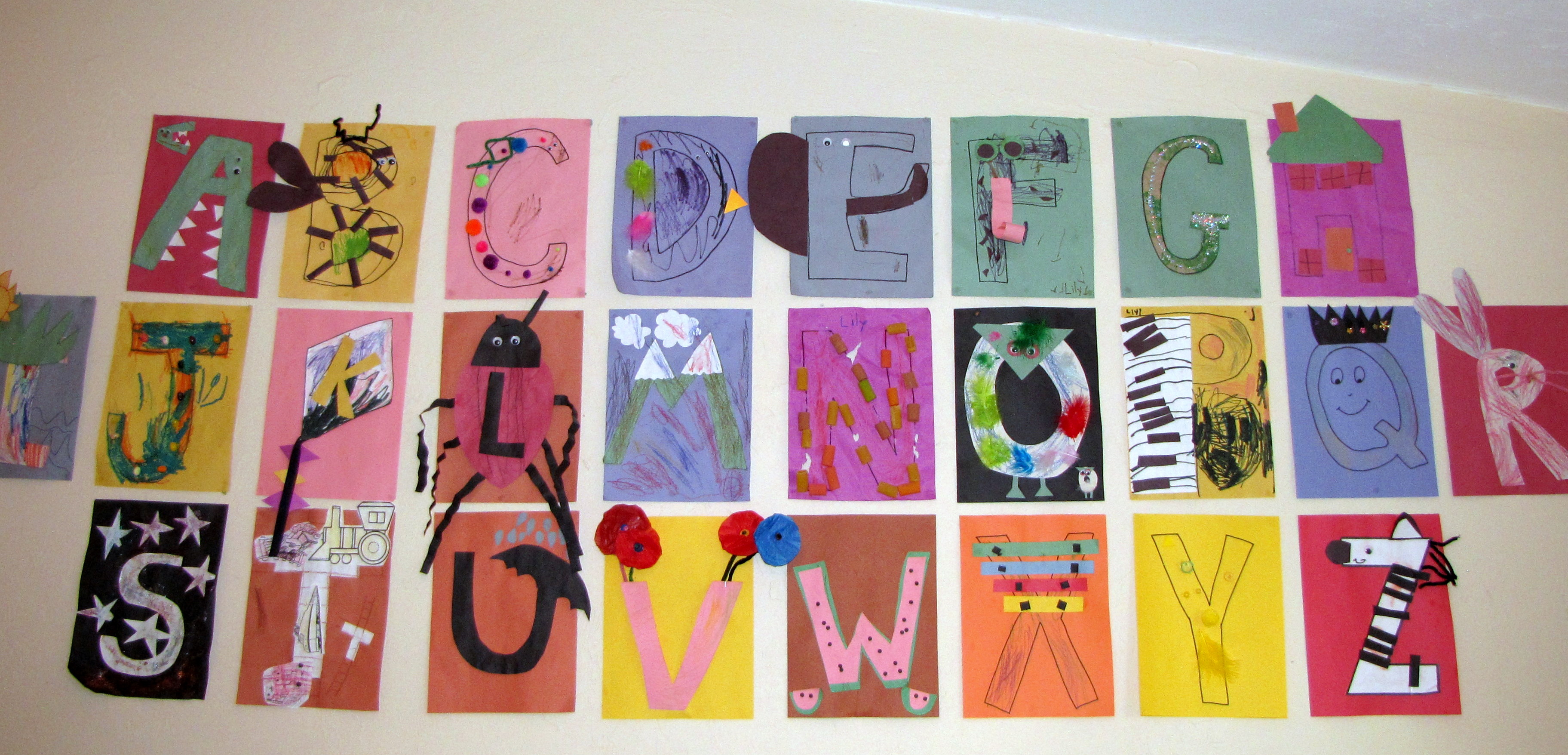 After 9 months, the Sweet Bee and I have finished our crafty tour of the alphabet. I don’t have individual pictures of each letter, but here is the rundown if you can’t tell from the photo:

